

We had a lovely day.
Meal info to come. Maybe. 🙂


I had picked up some tofu to try it out when I made Pho awhile back, mostly out of curiosity. I don’t miss the protein portion on my plate when it’s absent from a meal, and I get plenty of protein in my diet from the grains and legumes that I eat (and I also still consume dairy from time to time).
But shortly after that, Claudia ran across tofu at Aldi’s and picked up a block for me, figuring that I’d find some use for it. I searched for something along the lines of “best way to prepare tofu” and got several returns for scrambles. It seemed like a fairly simple, almost elegant way to use the product, so I narrowed down the search and came up with three iterations that informed this meal.
I grabbed a potato masher and was ready to go, except for one odd thing that was not in our pantry. More than one article listed a spice called Kala Namak as an essential ingredient to get an “eggy” flavor. At $4 for 3 1/2 ounces, I figured it was worth picking some up to try and have on hand. It is a pinkish salt from the Himalayas, but despite its hue it is generally referred to as “black salt.” It has a slightly sulfurous aroma, as one might expect.
I used the spices and proportions from this recipe at Loving It Vegan. We didn’t have soy milk so I substituted almond. I also started with a sauté of Portobello Mushrooms and spinach in the pan before adding the tofu, and used olive oil instead of vegan butter.
Here’s the sauce, the way I made it.
2 Tbsp Nutritional Yeast
1/2 tsp Turmeric
1/2 tsp Paprika
1 tsp Dijon Mustard
1/2 tsp Garlic Powder
1/4 tsp Black Salt (Kala Namak)
1/4 tsp Onion Powder
1/3 cup Almond Milk
I whisked that together in a measuring cup while the mashed tofu and veggies were heating. Once I added it to the pan and tasted, it still seemed just a bit bland to me, so I added another 1/4 tsp of the Kala Namak, some fresh ground black pepper and a little bit of my favorite barbecue spice mix.
This turned out to be a decent meal. It’s not something that I would go out of my way for, but if someone served it to me and I didn’t know better, I would think it was eggs. The main difference is that in our household scrambled eggs get loaded with cheese, and although the nutritional yeast adds some cheesy flavor, the gooey texture isn’t there. I suppose we could use some vegan cheese if we wanted, but it’s not something we keep on hand.
The nice thing about preparing a meal like this is knowing that if someone I love had a dietary restriction that precluded eggs, whether for ethical or health reasons (albumen allergy or cholesterol limits, etc.) I could still turn out a satisfying, flavorful, traditional breakfast dish for them. This makes me happy.

I made cheese soup for Sunday Dinner this week, and baked a nice peasant boule to go with it.
The cheese soup recipe is one my sister gave me many years ago. It was one of the specialty dishes of a restaurant in the town where we grew up (The Brown Jug in Decatur, Illinois). It’s one of my favorites, especially during the autumn and winter, with cooler weather.
The bread is the master recipe from Artisan Bread in Five Minutes a Day. Claudia had requested the book for Christmas many years ago, but didn’t really get into it. At some point I became interested in trying to rely less on “manufactured food” and picked up the book, thinking that I would bake bread for us every day.
I haven’t picked up that habit yet, but I do love the way these loaves turn out, and nothing could be much simpler to make, once you get your hands on a Danish Dough Whisk, a wooden peel and a baking stone (which are all pretty necessary to the process).
I used 5 1/2 cups of all purpose flour and 1 cup of whole wheat. That gets stirred together with 3 cups of lukewarm water, and 1 1/2 tablespoons each of kosher salt and yeast. Once it rises overnight, I’m ready to bake, and the dough that’s left will keep in the refrigerator for a week or two. I usually get three or four nice sized boules per batch.
One of these days, I’d like to try my hand at sourdough. Claudia gave me a copy of the Tartine Bakery’s book, and I may delve deeper into it one of these days. But it is honestly hard to beat the AB5 bread for ease of preparation, time invested, and the simple, delicious beauty of the finished product. It has the combination of chewy crumb and crunchy crust that I adore, and the addition of some whole wheat flour, or whole wheat and a little rye, gives it just enough funk for my taste.
The bread board was my mother’s, and I believe that it had originally been her grandma’s, so it is likely over 100 years old. It’s something else that I love for its simple beauty.


For Sunday Dinner this week we grilled Cedar Planked Salmon, Brussels Sprouts and baked potatoes. Claudia made a nice salad, and baked an incredibly delicious chocolate and peanut butter cake for dessert.
For the salmon, I simply soak the planks in water for a couple hours, then place them on the grill to char a bit before turning them over and setting the salmon on them to cook for maybe 20 minutes. The salmon had been seasoned with Pork Producers seasoning, Old Bay and a sprinkle of Turbinado Sugar. I did the Brussels Sprouts on the plancha with a little olive oil, salt and pepper.
Claudia used a yellow cake mix, adding peanut butter and chocolate to some of the batter, and then drizzling Wilton PB melt over the chocolate frosting.

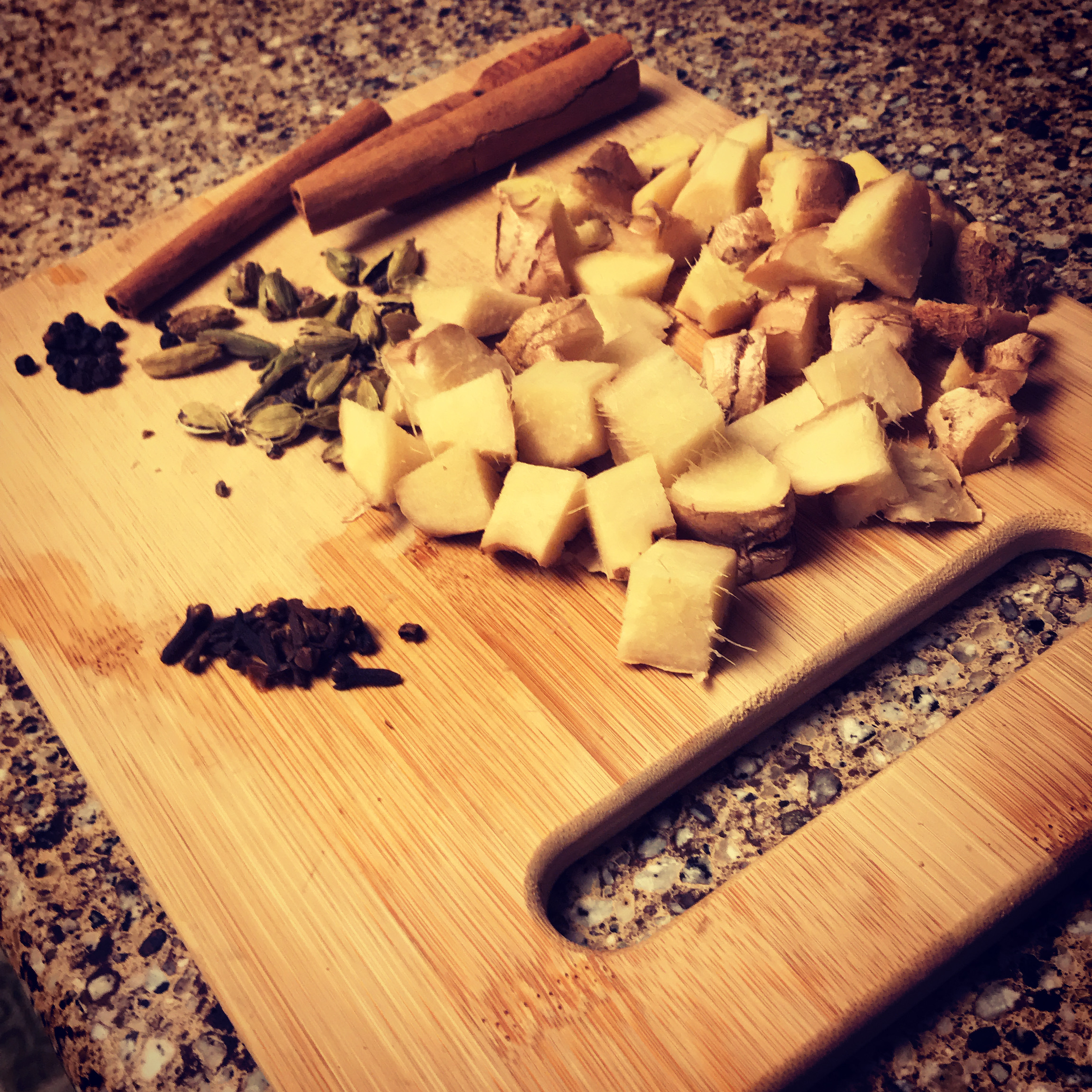
Good for grounding, energy, digestion and detox, “Yogi Tea” is one of our favorite beverages.
Our friend (and Kundalini Yoga teacher) Warren Armstrong introduced us to this marvelous tea. It was popularized in America by followers of Yogi Bhajan. Warren serves it after Gong Healing sessions to help restore balance and equilibrium. It is also excellent for reducing inflammation. I sometimes drink it to help with joint pain or muscle soreness.
I researched recipes online and brewed several batches before arriving at our variation on the process. We brew two quarts at a time, and keep it in the refrigerator to drink either cold (diluted with a little water) or hot (warmed in the microwave with almond milk and honey or raw sugar).
Get two quarts of water boiling while preparing the ingredients.
Crack open the cardamom pods with the flat of a chef’s knife, and cube up a five or six inch piece of ginger. There’s no need to peel the ginger first.
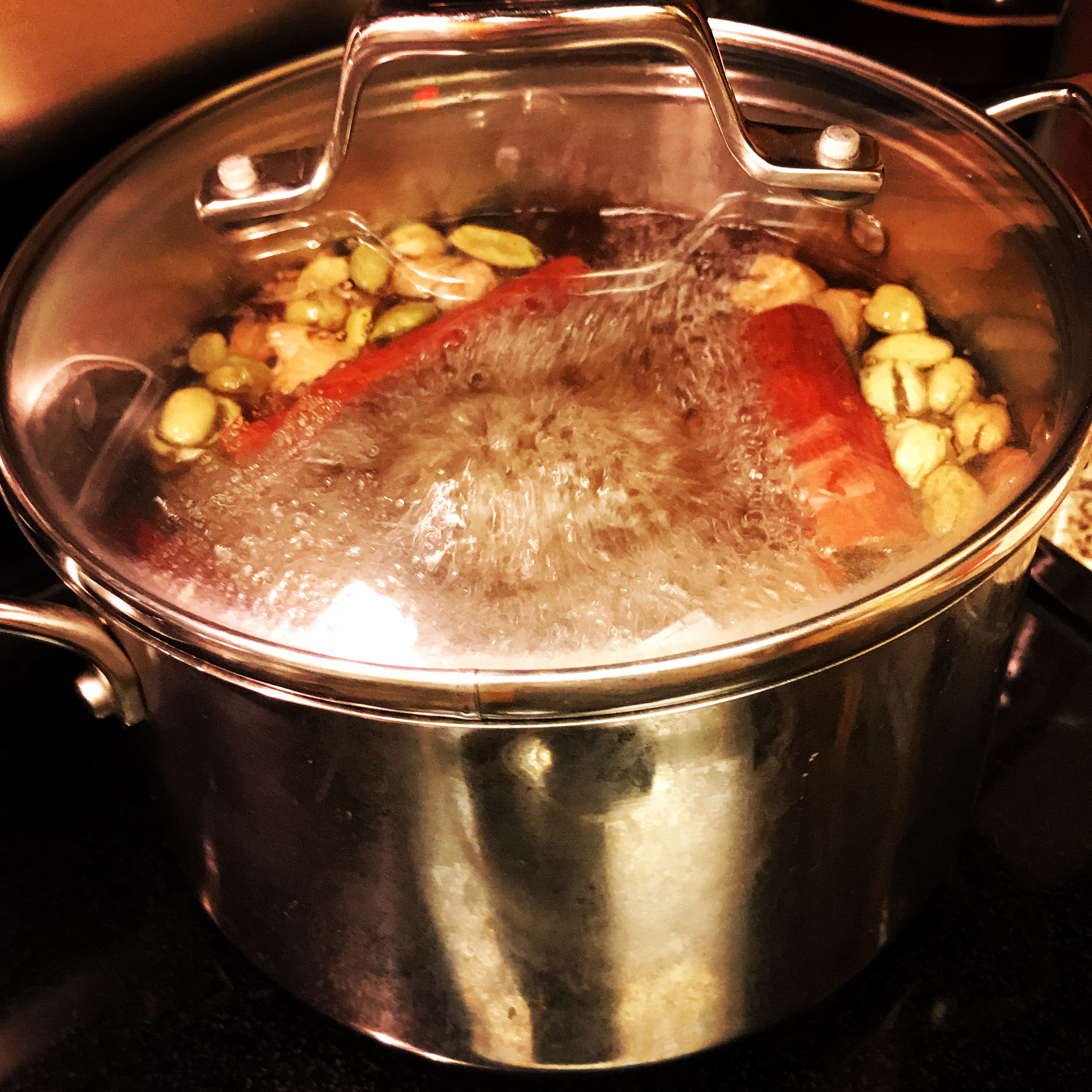
Once the water is boiling, add the cloves and let them boil for a minute or so before adding the other ingredients. Add everything else except the black tea, return to a boil, then lower the heat and simmer, covered, for thirty minutes. Remove from heat, add the tea bags, and cover to steep overnight (or at least six hours). Strain into a container, and add water to replace what has evaporated to make two quarts.
If serving cold, I dilute about half and half with water. For hot tea, the ratio is 2/3rds tea and 1/3rd milk. You may sweeten either, if you’d like. I prefer it without sweetener when cold, but with just a taste of honey or raw sugar when hot.